Event-Driven Design: Choosing Between SNS, SQS, and EventBridge
The three AWS messaging services people mix up: SNS for pub/sub fan-out, SQS for durable queued work, EventBridge for rule-based event routing. What each one is actually for, and the hybrid patterns (SNS plus SQS, EventBridge plus SQS) that combine them.
Originally published on DEV.to ↗.
Event-driven design is a cornerstone of modern application architecture, especially in serverless systems where decoupled components must communicate efficiently.
In the world of AWS there are three messaging and event-routing services:
- Amazon Simple Notification Service (SNS)
- Amazon Simple Queue Service (SQS)
- Amazon EventBridge.
Each service excels in different scenarios, therefore understanding their nuances can help you design robust and scalable solutions.
Amazon SNS: Publish/Subscribe Messaging#
Amazon SNS is a fully managed publish/subscribe (pub/sub) service. It allows a publisher to send messages to multiple subscribers simultaneously.
Key Features:
- Broadcast Messaging: SNS pushes messages to multiple subscribers in real-time.
- Multiple Protocol Support: Subscribers can receive messages over HTTP/S, email, SMS, or AWS services like Lambda and SQS.
- Fan-Out Pattern: Combine SNS with SQS to ensure message durability while maintaining pub/sub communication.
When to Use SNS:
- Real-Time Updates: Notify multiple systems or users about an event immediately (e.g., sending order confirmation emails and updating a dashboard).
- Fan-Out Architecture: Distribute messages to multiple processing pipelines (e.g., log processing, alerting systems).
- Cross-Region Notifications: Enable globally distributed applications to communicate efficiently.
Example:
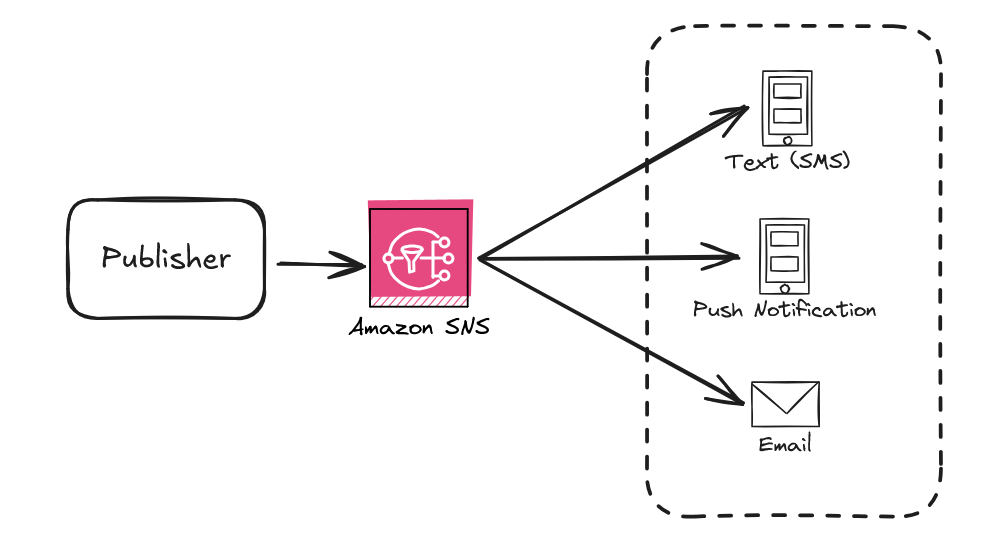
A news publishing platform uses SNS to notify users of breaking news. Each subscriber chooses a preferred delivery channel—email, SMS, or mobile push notifications.
Example Architecture:
Amazon SQS: Decoupled Queuing#
Amazon SQS is a fully managed message queuing service. It decouples components of distributed systems, allowing them to communicate asynchronously.
Key Features:
- Message Durability: Messages are stored until they are processed or expire.
- Processing Guarantee: Messages are delivered at least once (Standard Queue) or exactly once (FIFO Queue).
- Scalability: Supports massive throughput and unlimited queue size.
When to Use SQS:
- Task Queues: Process tasks asynchronously, such as image processing or order fulfillment.
- Message Retention: Ensure messages are not lost if a consumer is temporarily unavailable.
- Rate Limiting: Buffer requests to avoid overwhelming downstream systems.
Example:
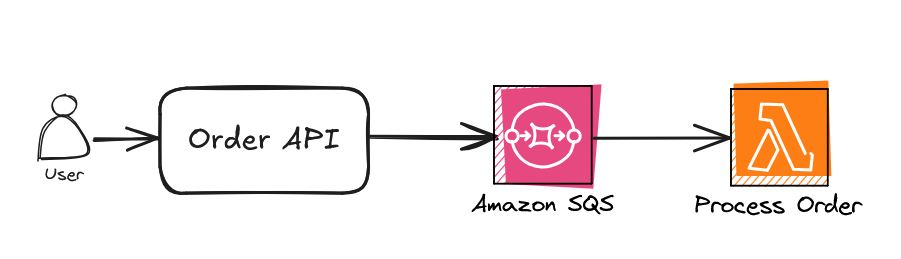
An e-commerce platform uses SQS to manage order processing. Orders are added to a queue and processed asynchronously by a fleet of worker instances.
Example Architecture:
Amazon EventBridge: Event Bus for Rule-Based Routing#
Amazon EventBridge is an event bus service that allows you to ingest and route events from various sources based on customizable rules.
Key Features:
- Event Routing: Route events to multiple targets based on rules.
- Integrated Sources: Ingest events from AWS services, SaaS applications, or custom applications.
- Schema Discovery: Automatically discover and use schemas for events.
When to Use EventBridge:
- Event-Driven Workflows: Trigger workflows or orchestrate tasks based on specific event patterns (e.g., serverless pipelines).
- Complex Routing: Implement fine-grained routing logic for event processing.
- Integrating SaaS Applications: Easily connect third-party SaaS events into your workflows.
Example:
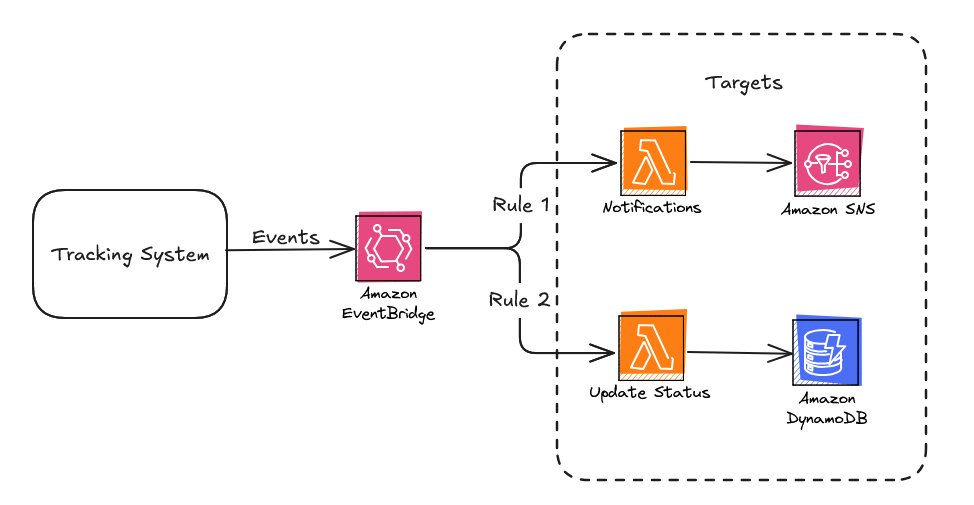
A logistics company uses EventBridge to trigger a Lambda function when a shipment's status changes in its tracking system, enabling real-time notifications to customers and automated updates to internal dashboards.
Example Architecture:
Choosing the Right Service#
The choice between SNS, SQS, and EventBridge depends on your use case:
| Feature | SNS | SQS | EventBridge |
|---|---|---|---|
| Message Type | Pub/Sub | Queue | Event Bus |
| Delivery Model | Push | Pull | Push |
| Routing Capability | Limited | None | Advanced |
| Durability | Limited (requires SQS for durable fan-out) | High | High |
| Use Cases | Real-time notifications, fan-out | Task queues, async processing | Event-driven workflows |
Hybrid Patterns#
Combining these services can unlock even greater flexibility. For example:
- SNS + SQS: Use SNS for fan-out to multiple SQS queues, ensuring durability and decoupled processing.
- EventBridge + SQS: Route events to specific SQS queues based on event patterns for targeted processing.
Conclusion#
SNS, SQS, and EventBridge each play a vital role in event-driven architectures. SNS excels in real-time pub/sub messaging, SQS in decoupled queuing, and EventBridge in advanced event routing. By evaluating your requirements, you can choose the right service or combination of services to build your robust and scalable solution.